
Move business websites beyond
the limits of legacy CMS delivery
GridOS is built for brand sites, product sites, and multilingual experiences. It helps new sites launch with a stronger structure, lets older sites migrate without unnecessary friction, and makes future updates easier to sustain.
A better fit for solving
real website problems
More modern for new builds
It suits today's brand sites, product storytelling sites, and export websites without forcing the experience into the limits of a traditional CMS.
Legacy habits can still carry over
If a team is already familiar with the old site's structure and usage model, GridOS can preserve that overall experience while improving the page layer underneath.
Easier to maintain after launch
From content updates to language expansion, landing pages, and campaign pages, future work is less likely to be slowed down by an aging architecture.
A stronger fit for richer hero sections and interior pages
From the homepage to cases, news, products, and contact pages, the brand expression can stay consistent across the whole site.
Better suited for overseas and additional language rollout
It is not limited to Chinese and English. As more languages are added later, structure consistency and update efficiency are easier to keep under control.
A clearer product structure
for multi-site delivery
Site foundation
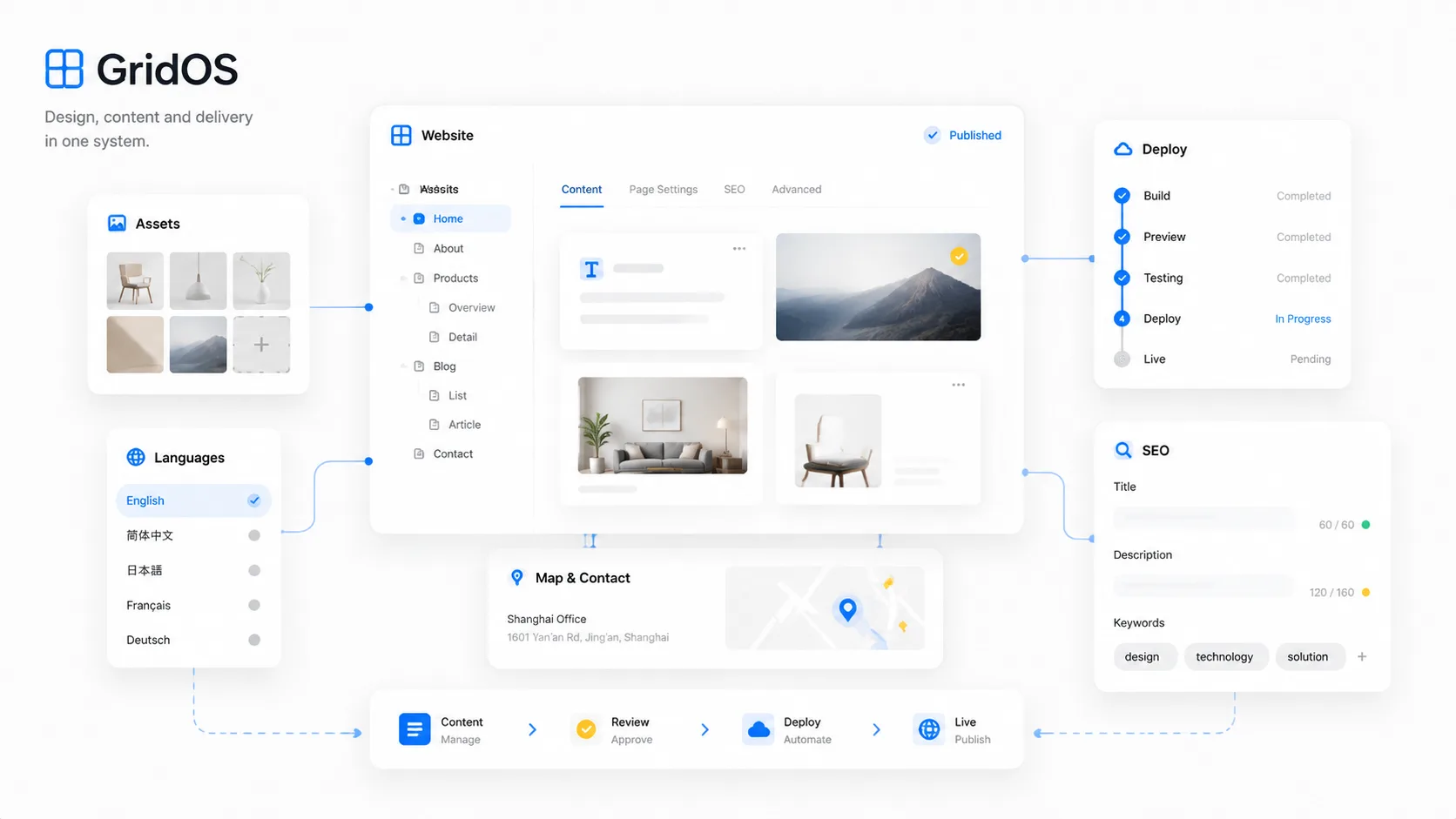
Manage each site's brand info, contact settings, SEO defaults, map data, and publishing context from one shared base.
Content structure
Keep navigation nodes, pages, products, news, and case content inside the same structured model instead of scattering them across templates.
Media and localization
Treat galleries, covers, QR codes, and language variants as reusable system objects instead of page-level patchwork.
Build and launch workflow
Connect preview, build, deployment, and later iteration through one operating chain so teams spend less time switching contexts.
AI works inside structured content
instead of replacing page design
Generate first-pass copy for pages, product sections, campaign blocks, and regional landing pages inside defined content fields.
Translate and refine locale variants against the same entity model so multilingual work stays consistent over time.
Fill summaries, keywords, alternative titles, and image descriptions as structured metadata rather than loose notes.
Review missing fields, language gaps, and structural inconsistencies before a build or deployment goes out.
A lighter website architecture
usually leads to a better page experience
GridOS uses a lighter static delivery model, which makes it easier to hold strong results on load speed, script weight, and overall stability. The chart below gives a quick comparison using commonly cited public benchmarks across familiar stacks.
From planning the site structure
to launch and later iteration
Plan the structure
Clarify the homepage, product sections, cases, news, and language entry points first so the entire site starts with better order.
Build the expression system
Create a unified page system around the brand and product so different pages still maintain a consistent level of presentation quality.
Connect the content layer
Bring categories, hero slides, galleries, navigation, and multilingual content into one shared management model.
Launch and iterate
After go-live, keep adding languages, campaign pages, new sections, and regular updates without being dragged down by the old system.